Like a lot of retailers, we moved to Shopify during the pandemic. I didn't expect that decision to eventually lead me to building my own app — but once I understood what the platform could do, I couldn't unsee the problem it could solve.
I've been in retail for over 30 years. I run two stores — a clothing and footwear shop, and a skateboard shop. Different customers, different products, different vibes. But the same daily headache: getting the right product from the stockroom onto the sales floor, consistently, across multiple staff members and multiple shifts.
It sounds simple. It never is.
The Problem I Lived Every Day
Here's what restocking actually looks like in a busy retail store.
Something sells. Maybe it's a pair of shoes in a popular size, or a deck that a kid's been eyeing for weeks. The item is gone from the floor. In the stockroom, there's another one waiting.
But nobody knows it needs to go out.
Not because the staff don't care — they do. But they're busy. They're helping customers, processing transactions, handling a dozen other things at once. Figuring out what sold and what needs restocking means exporting a csv, checking a report, walking the floor, asking the manager, or just trying to remember. And if a shift ends before it gets done, the next person coming in has no idea where things stand.
Across two stores, this was happening every single day. Product sitting in the stockroom. Gaps on the floor. Sales we never made because the item wasn't visible when the customer was standing there.
I knew there had to be a better way. I just hadn't found it yet.
The Shopify Moment
When we moved to Shopify during the pandemic, I spent a lot of time learning the platform. And the more I understood it, the more I realized something: all the data I needed was already there.
Shopify knows exactly what sold. It knows current inventory levels. It knows what's been depleted. The information exists — it just wasn't being surfaced in a way that was useful to a staff member standing on the sales floor trying to figure out what to restock next.
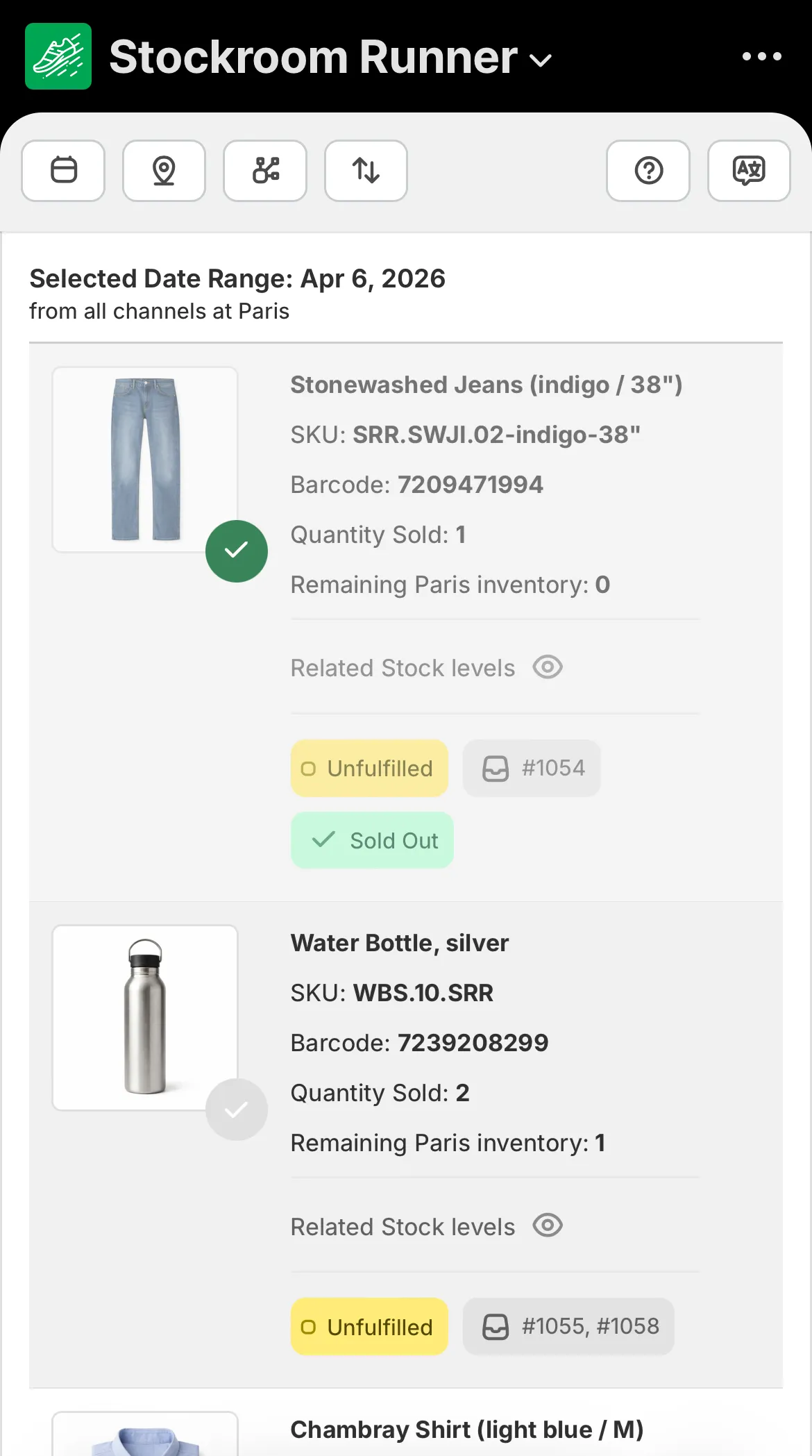
That's when the idea clicked. What if that data could automatically become a checklist? A simple, visual list of what sold and what needs to go back on the floor — with a photo of each product along with data points. Any staff member could identify it instantly, and a way for the whole team to see what's been done and what still needs attention.
So I applied my previous 20 years of programming experience and got to work.
What Stockroom Runner Actually Does
The result is Stockroom Runner — and the core concept is beautifully simple.
As items sell in your Shopify store, they appear on a visual checklist. Each item shows a product photo, the name, SKU, barcode, and current inventory levels. Staff check items off as they restock them. Everyone on the team sees the same list in real time. When a shift ends and a new one begins, the incoming staff member opens the app and immediately knows exactly what's been done and what still needs attention. Days where all items as marked as checked show as green in the date picker so you know all products from that day are taken care of.
That's it. No reports to run. No spreadsheets. No guessing. Setup takes under five minutes and it runs entirely inside your Shopify admin.
What Changed in Our Stores
I built this for my own stores first. Here's what actually changed.
The sales floor stays fuller. When restocking is a clear, automatic list rather than a mental exercise, things get done. Items don't sit in the stockroom for half a shift while the floor has gaps.
Shift handoffs stopped being a problem. Before, the end of a shift meant a verbal handoff at best, nothing at worst. Now the list speaks for itself. The incoming staff member doesn't need to be briefed — they just open the app.
Staff stopped having to make judgment calls they weren't equipped to make. Nobody had to decide what probably sold or what might need restocking. The list is just there. Work the list, move on.
I stopped spending time managing the restocking process. As an owner running two stores, I'm not always there. A system that runs itself — or close to it — is the difference between a store that functions well in your absence and one that doesn't.
It Works Across Both Stores
One thing I wasn't sure about when I built this: would it work as well for the skate shop as it did for the clothing store? The product mix is completely different. The customers are different. The pace is different.
It works exactly the same in both. The app doesn't care what you're selling — it just surfaces what sold and what needs to go back out. Whether that's a size 10 running shoe or an 8.25" deck, the process is identical.
If it works for a clothing store and a skate shop running simultaneously, it works for your store.
Built by a retailer, for retailers
Stockroom Runner gives your team a clear, visual checklist of everything that sold and needs restocking — automatically, every day. Set up in under 5 minutes.
Try Stockroom Runner Free →Why I'm Sharing This
I'm not a software company that stumbled into retail. I'm a retailer who spent 30 years dealing with this problem before I had the tools and knowledge to solve it.
Stockroom Runner exists because I needed it and nobody had built it yet.
If you're running a brick-and-mortar Shopify store and your sales floor isn't staying as full as it should — if your staff are spending time figuring out what to restock instead of just doing it — this is worth trying. The free trial takes five minutes to set up. You'll know within a day whether it's making a difference.